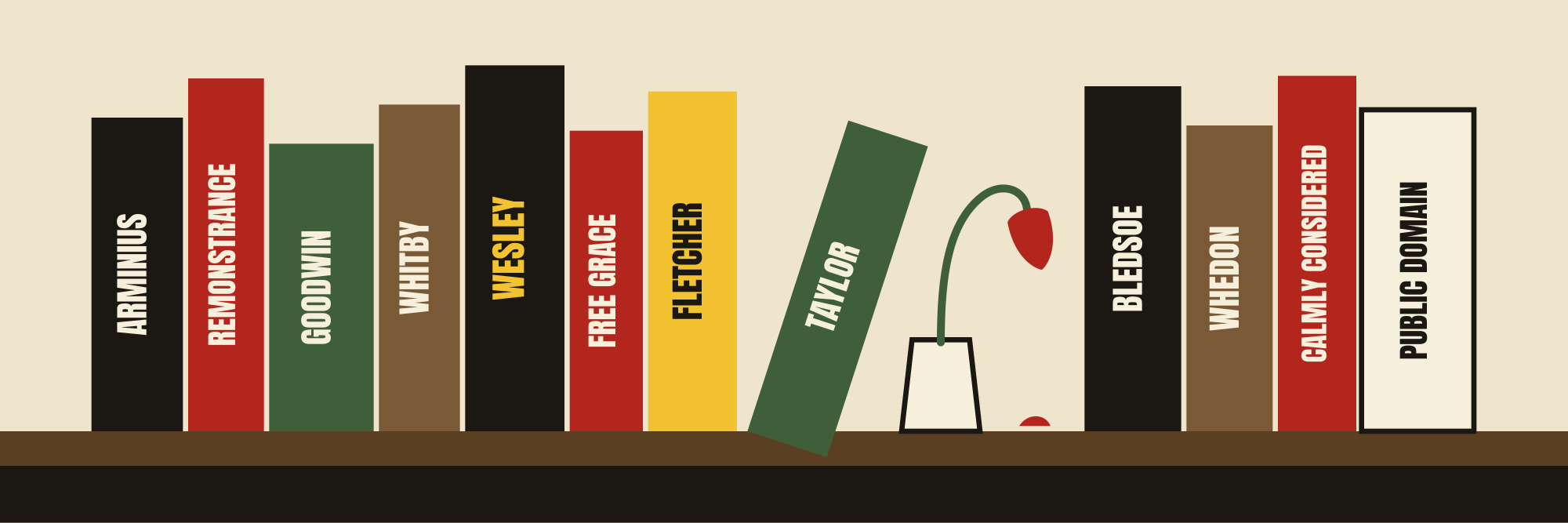
Free. Forever. Public domain.

The Anti-Calvinist Library

The classic case against unconditional election, limited atonement and irresistible grace, in the words of the people who made it. Every title here is in the public domain, so read it, print it, copy it, and pass it on.

Christ's death: sufficient for all, offered to all, effective for all who believe.

The Remonstrants

Holland, 1600s

A Declaration of the Sentiments of Arminius

Jacobus Arminius · 1608

Arminius's own statement before the States of Holland. He sets out the supralapsarian and infralapsarian schemes of predestination, explains why he rejects both, and gives his own view: God elects believers in Christ.

Read here (English + Dutch)
Edition: our own new translation from Arminius's Dutch (Leiden, 1610)

The Remonstrance of 1610 (the Five Articles)

The Remonstrants · 1610

The Arminian ministers' petition to the States of Holland, in full: the five Calvinist doctrines they rejected, then the five articles they taught instead (conditional election, an atonement for all enjoyed only by believers, the necessity of grace, resistible grace, and an open question on perseverance). The Synod of Dort's Canons were written to rebut it point by point.

Read here (English + Dutch)
Edition: our own new translation, beside the Dutch of the first printing (The Hague, 1612)

The Remonstrant Confession (1621)

Simon Episcopius, for the Remonstrant pastors · 1621

The Arminians' full confession, written in exile after the Synod of Dort. Twenty-five chapters on Scripture, God, grace, faith, and the church, with grace that is sufficient for all who are called and can be resisted, a church that holds few things necessary, and a flat rejection of persecution for conscience. New public-domain translation from the 1622 Latin, shown side by side with the original.

Read here (English + Latin)
Edition: our own new translation from the 1622 Latin

English Arminians

1650–1710

Redemption Redeemed

John Goodwin · 1651

A Puritan pastor's full-length case that Christ died for all people, while only those who believe are saved. He wrote from inside the Reformed camp; John Owen himself answered him, and opponents called him "the great spreader of Arminianism."

Read here
Edition: 1651 first edition, from the EEBO-TCP transcription

Discourse on the Five Points

Daniel Whitby · 1710

An Anglican scholar takes up election, the extent of redemption, grace, free will and perseverance one at a time. This is the book John Gill's Cause of God and Truth and Jonathan Edwards's Freedom of the Will were written to answer.

Read here
Edition: the first edition (London, 1710)

The Methodist Controversy

1739–1780

Free Grace

John Wesley · 1739

The sermon that split Wesley from Whitefield. Grace, Wesley says, is free in all and free for all, and he argues that unconditional reprobation makes preaching vain and contradicts God's love.

Read here
Edition: the first edition (Bristol, 1739)

A Dialogue Between a Predestinarian and His Friend

John Wesley · 1741

Wesley lets Calvin, Zanchius, Piscator and the Westminster divines speak for themselves, quoting them in sequence, and asks the reader whether these are words they are willing to own.

Read here
Edition: first edition (London, 1741)

Predestination Calmly Considered

John Wesley · 1752

Wesley's longest and most careful treatment. He shows that election entails reprobation, then weighs the doctrine against God's justice, mercy, sincerity and the universal invitations of the gospel.

Coming soon to this site
Read elsewhere (free): 1752 first edition (scan)
In preparation from the first edition (London, 1752)

The Question, "What Is an Arminian?" Answered

John Wesley · 1770

A few pages, written "by a lover of free grace" to clear up what Arminians actually believe. It is the best place for a curious Calvinist to start.

Read here
Edition: first edition (London, 1770)

Thoughts upon Necessity & Thoughts upon God's Sovereignty

John Wesley · 1774 & 1777

Two short pieces. The first takes on philosophical determinism, the idea that every choice is fixed in advance and none is truly free. The second shows how God's sovereignty as Creator and his justice as Governor fit together without making him the author of sin.

Necessity (1774) · God's Sovereignty (1777)
Edition: first editions (London, 1774 and 1777)

A Solemn Caution Against the Ten Horns of Calvinism

Thomas Taylor ("Philalethes, lately escaped") · 1780

A former Calvinist writes to Wesley listing ten consequences he believes follow from absolute predestination. It is short, sharp, and was reprinted for decades.

Read here
Edition: the first edition (1780)

Americans Answer Edwards

1845–1864

An Examination of President Edwards' Inquiry into the Freedom of the Will

Albert Taylor Bledsoe · 1845

A lawyer and mathematician takes Edwards's famous argument apart definition by definition, arguing that its idea of a caused volition runs in a circle.

Read here
Edition: 1st ed. (Philadelphia, 1845), from Project Gutenberg

The Freedom of the Will as a Basis of Human Responsibility and a Divine Government

Daniel D. Whedon · 1864

The Methodist answer to Hobbes, Edwards and the Princeton theologians. Whedon argues that without a real power of choice there can be no responsibility and no just judgment.

Read here
Edition: the 1864 New York printing (Carlton & Porter)

The Systematic Theologies

1823–1894

Theological Institutes

Richard Watson · 1823–1829

The first full systematic theology of Wesleyan Arminianism and the standard Methodist textbook for half a century. Chapters 25–28 take up the extent of the atonement, the passages said to limit it, and the theories that would.

Read here: Theological Institutes, Volume I · Read here: Theological Institutes, Volume II, in progress
Edition: the first London edition (1823–1829)

A Treatise on the Faith of the Free-will Baptists

Free-will Baptist General Conference · 1834

The Baptist answer. It teaches that Christ died for the sins of the world, that the gospel call goes to everyone, that God's foreknowledge does not cause what it foresees, and that salvation is received by faith.

Read here
Edition: 1834 first edition (Harvard copy)

Elements of Divinity

Thomas N. Ralston · 1847

A Kentucky Methodist's lecture course, written to be taught. Four lectures argue the extent of the atonement, followed by one comparing Calvinism and Arminianism side by side and two on human moral agency.

Read here
Edition: the 1851 Louisville printing from the 1847 plates

A note on the texts

Every book here is in the public domain and is read here, on this site, as text: always the original edition, and for books first written in another language, our own new translation beside the original. Each book carries a note on the edition it reproduces. Books marked “coming soon” are still being prepared. Old books reflect their own times. We list them for their arguments about grace, not as an endorsement of every opinion their authors held. None is offered here as teaching that all people will be saved: the common thread is that Christ died for all and that salvation is received by faith (Mark 16:16).